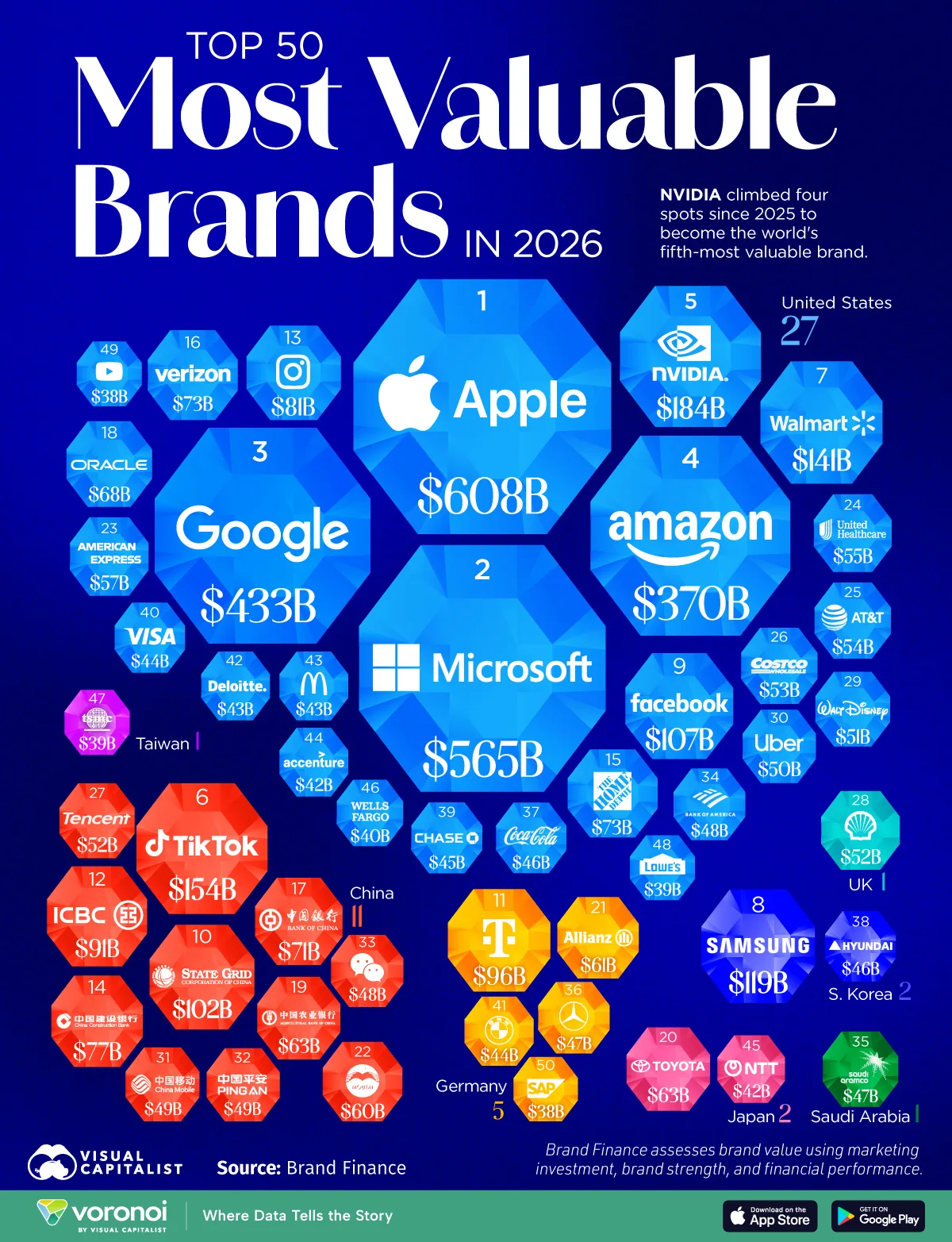
In 2026, the landscape of global brand dominance is being fundamentally rewritten by the “AI-first” economy, where market leaders are no longer just software providers but essential infrastructure partners. At the summit, Apple maintains its status as the world’s most valuable brand at $608 billion, successfully pivoting its identity toward a privacy-first AI ecosystem that embeds “Apple Intelligence” directly into the pockets of billions. However, the most explosive shift comes from NVIDIA, which has surged to the fifth spot globally with a brand value of $184 billion—a 110% increase that reflects its near-monopoly on the silicon powering the generative AI revolution. Meanwhile, Microsoft and Google continue to consolidate power by transitioning from traditional search and office tools to agentic operating systems, where AI agents now perform complex, high-value workflows autonomously. This year marks a “flight to trust,” as consumers and enterprises alike gravitate toward legacy giants that can successfully industrialize AI while maintaining rigorous standards for data ethics and reliability.
Top Global Brands That Dominate Their Industry (2026)
You’re probably using a product from a top global brand right now. Whether you’re reading this on an iPhone, sipping a vanilla latte, or wearing a pair of sneakers that arrived on your doorstep in less than 24 hours, these names aren’t just logos—they are the invisible scaffolding of our daily lives. In 2026, the lines between “tech company” and “lifestyle partner” have blurred more than ever. Brand value has shifted from being a boardroom metric to a reflection of how much we trust a company to handle our data, our dinner, and our downtime. Today, Apple continues to lead the charge as the world’s most valuable brand, boasting a staggering brand value of $608 billion. But how did we get here, and who is snapping at their heels?
Why Brand Value Matters to You
When we talk about “brand value,” it’s easy to get lost in the billions. In plain English, brand value is simply the premium we are willing to pay for a name we trust. It’s why you’ll choose a specific grocery store for its produce or trust a certain food delivery app to get your Thai food to you hot and on time.
The biggest brands in the world do more than just sell products; they shape our culture. They set the prices we consider “normal,” dictate the trends we see on social media, and even influence the global food landscape. When a brand dominates, it’s because they’ve moved past being a commodity and become a habit. As we look at the leaders of 2026, the question isn’t just about who has the most money, but who has the most “real estate” in our daily routines.
The Tech Giants Leading the Pack
If your digital life feels like it’s managed by a handful of companies, you aren’t imagining it. The top four spots—Apple, Microsoft, Google, and Amazon—remain the undisputed heavyweights of 2026. However, the biggest story this year is the meteoric rise of NVIDIA, which has officially climbed into the fifth-place spot.
-
Apple: Beyond just hardware, their ecosystem loyalty is at an all-time high, driven by seamless services and health-tech integration.
-
Microsoft: They’ve secured their future through absolute dominance in cloud computing and integrated AI tools.
-
Google: From Search to Android, Google remains the oxygen of the internet.
-
Amazon: They’ve mastered the art of “everything,” from AWS backend services to the physical groceries in your kitchen.
-
NVIDIA: Once known only to gamers, they are now the AI chip brand that powers the entire modern economy.
If these names sound like your entire digital life—that’s kind of the point. They’ve moved from being tools we use to being the platforms we live on.
Beyond Tech: Retail, Food & Lifestyle Brands
While Silicon Valley takes the headlines, the famous companies list includes names you interact with physically every single day. Retail giants like Walmart (valued at $141 billion), Home Depot, and Costco prove that even in a digital world, we still value the scale and reliability of a massive physical footprint.
For the food-focused audience here at Samppy, the staying power of food and beverage icons is particularly fascinating. McDonald’s, Coca-Cola, and Starbucks aren’t just businesses; they are cultural touchpoints. These brands build loyalty through extreme consistency—whether you are in Des Moines or Dubai, a Big Mac tastes like a Big Mac. These global brand leaders understand that in a fast-paced world, the most valuable thing they can offer is a predictable, high-quality experience every single time.
Global Brand Leaders Outside the US
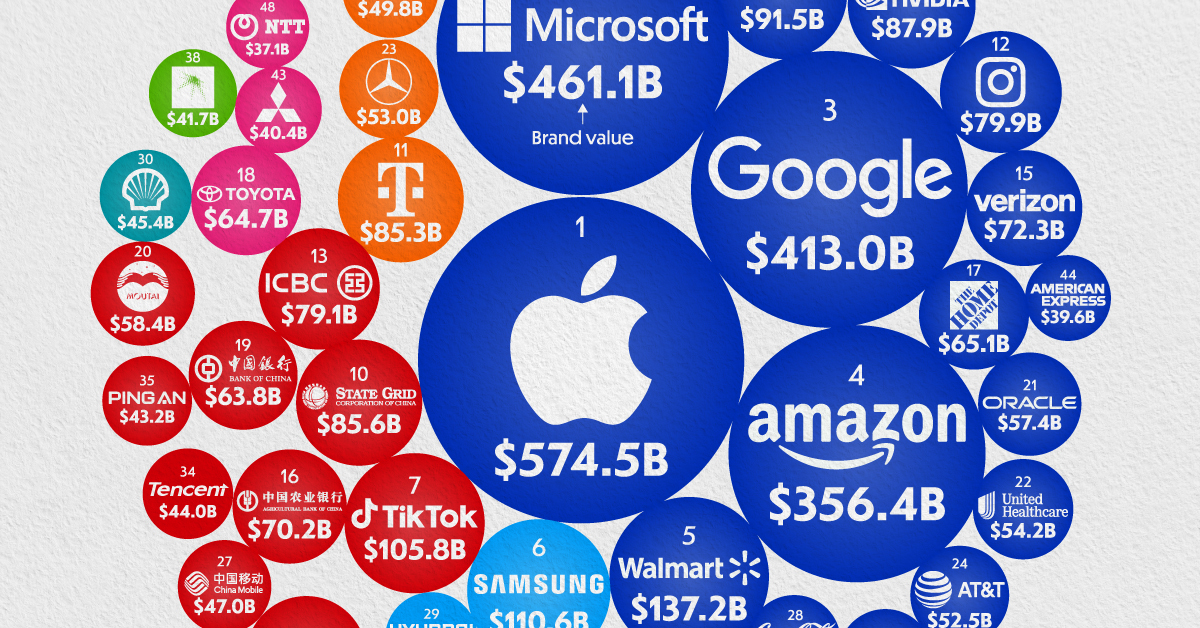
While American brands are powerhouse players, the biggest brands in the world have stiff competition from across the oceans. Samsung, valued at $110.6 billion, remains Asia’s strongest non-Chinese brand, proving that hardware innovation is a global language. Meanwhile, TikTok has solidified its place as a Chinese brand leader, surpassing $100 billion in value as it continues to dominate the attention span of global audiences.
In Europe, the focus remains on “generational trust.” Luxury icons like Louis Vuitton and Mercedes-Benz, along with beauty giant L’Oréal, show that heritage and craftsmanship still command massive market value. Whether it’s a French perfume or a Korean smartphone, these brands speak a universal language: quality.
What Makes a Brand Truly Dominate?
Becoming one of the top global brands isn’t an accident of history; it’s a result of specific, repeated behaviors. First, there is the matter of consistency. These companies don’t just have one good year; they deliver for decades. Second, they create an emotional connection. We don’t just “use” an iPhone; we feel like “Apple people.”
Lastly, the ability to evolve is non-negotiable. Whether it’s pivoting toward sustainability or integrating AI, the leaders of 2026 are those who weren’t afraid to change their core product to meet new consumer demands. Trust is built over time, but it’s maintained by staying relevant. The brands you keep going back to? They’ve earned it by staying one step ahead of your needs. 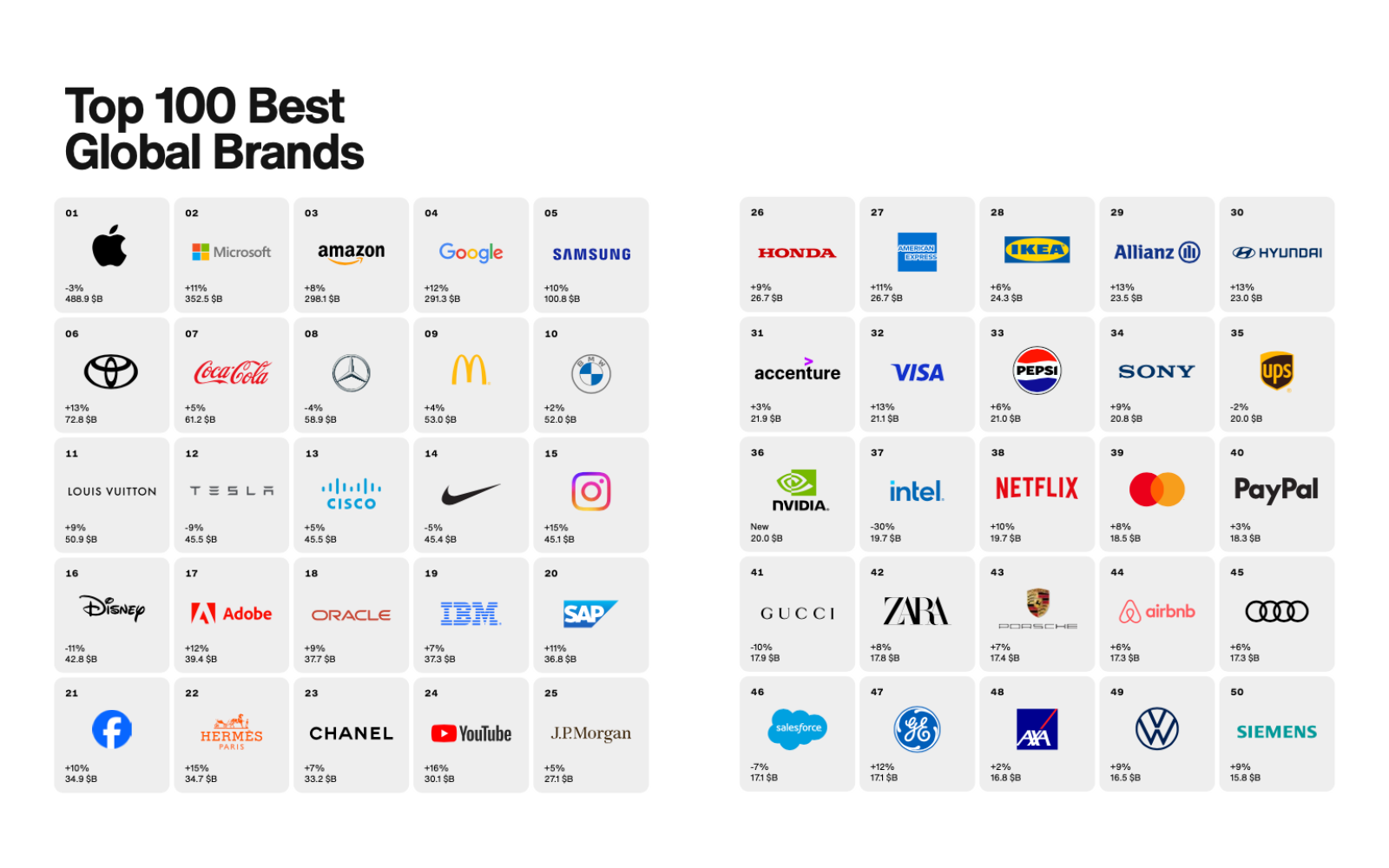
Staying Ahead of the Curve
Behind every massive logo and multi-billion dollar valuation is a product that someone like you chose to trust. As we navigate 2026, these top global brands will continue to influence how we eat, shop, and communicate.
Whether it’s Apple holding the crown with its $608 billion valuation, Nvidia revolutionizing the industry through AI infrastructure, or TikTok reshaping global culture, these companies are no longer just sellers—they are partners in our daily lives.
Even the global brand leaders in the retail and lifestyle sectors, like Walmart, Samsung, and McDonald’s, prove that reliability and emotional connection are just as valuable as the latest code. Trust is the ultimate currency, and the names that dominate are the ones that have learned to evolve without losing their core promise.
The landscape is always shifting, especially when it comes to what we consume and how we live. Curious how these global giants are specifically shaping what’s on your plate this year? Explore our deep dives in
to the latest dining trends and grocery innovations right here on brandsholder.com
Frequently Asked Questions
1. Which is the top global brand in 2026? Apple continues to hold the title of the world’s most valuable brand in 2026, with a brand value estimated at approximately $608 billion. This dominance is driven by high customer loyalty, its expanding services ecosystem, and a strong push into AI-integrated hardware.
2. Why did Nvidia’s brand value grow so quickly? Nvidia is the fastest-growing brand in 2026, more than doubling its value to $184 billion. This is largely due to its chips becoming the essential “backbone” of the global AI revolution, powering everything from data centers to generative AI platforms like OpenAI.
3. What is the difference between brand value and market capitalization? While often confused, they measure different things:
-
Brand Value: The financial value of the brand name and consumer perception itself (the “trust” factor).
-
Market Cap: The total value of all the company’s shares on the stock market. For example, while Apple’s brand is worth $608 billion, its total company value (market cap) is nearly $4 trillion.
4. Are there any non-US brands in the top 10? Yes. While US tech giants dominate the list, Samsung (South Korea) remains a powerhouse with a value of $119 billion. TikTok (China) also sits firmly in the top 10, valued at over $153 billion, reflecting its massive influence on global media and commerce.
5. How do food and retail brands compare to tech giants? While tech brands like Microsoft and Google have higher valuations, retail and food brands show incredible “brand strength.” Brands like Walmart ($141 billion) and McDonald’s remain global leaders because of their physical scale and the daily consistency they provide to billions of consumers.