A brand positioning statement is a short internal document usually two to four sentences that defines who your brand serves, what problem it solves, what makes it uniquely different from competitors, and why customers should believe that claim. It is the strategic foundation that guides every piece of marketing, messaging, and customer communication a business produces.
Most businesses think they have a brand. What they actually have is a logo and a tagline. A logo tells people what you are called. A tagline tells people something clever about you. But neither of those answers the one question that every potential customer is silently asking before they decide to buy:
“Why should I choose you over everyone else?”
That is exactly what a brand positioning statement answers, and it is the document that separates businesses that grow from businesses that compete on price and eventually disappear.
This guide gives you the exact formula, a step-by-step writing process, seven real-world examples, and a free template you can use today.
What Is a Brand Positioning Statement? (And What It Is Not)
A brand positioning statement is a concise internal document that defines the specific space your brand occupies in the minds of your target customers, relative to your competitors.
Three critical words in that sentence: internal, specific, and relative.
Internal means this is not your tagline and not your about page. It is a strategic document that guides your team, not advertising copy for billboards.
Specific means it names a real target audience, a real problem, and a real differentiator. Vague positioning statements are not positioning at all, they are corporate word salad.
Relative means positioning only exists in comparison. You are not defining what you do in isolation. You are defining why you are a better choice than specific alternatives for a specific type of customer.
What a Brand Positioning Statement Is NOT:
- It is not your mission statement (which describes your purpose and values)
- It is not your tagline (which is a short public-facing slogan)
- It is not your elevator pitch (which is a longer conversational explanation)
- It is not your value proposition (which focuses purely on customer benefit, not competitive context)
Why Brand Positioning Statements Matter More in 2026 Than Ever Before
The business case for a clear brand positioning strategy has never been stronger. Here is the data every business leader needs to see:
| Metric | Statistic | Source |
|---|---|---|
| Revenue impact of strong positioning | Brands with clear positioning grow 2–3x faster than competitors | McKinsey Brand Report 2025 |
| Consumer trust and brand choice | 88% of consumers say trust is as important as price when choosing a brand | Edelman Trust Barometer 2025 |
| Authenticity in brand decisions | 88% of consumers say brand authenticity influences which brands they support | Stackla Consumer Report |
| Purpose-driven brand preference | 71% of consumers say a brand’s values influence their buying decisions | Porter Novelli Purpose Study |
| Cost of weak positioning | Companies with unclear positioning compete primarily on price, reducing margins by 15–25% | Hinge Marketing Research |
| AI impact on brand discovery | 58% of consumers now use AI assistants to research brands before purchase | Gartner Digital Commerce 2025 |
The last row is the most important for 2026. AI search tools, including Google AI Overview, ChatGPT, and Perplexity are now synthesizing what is written about your brand across the web and presenting it directly to potential customers. If your brand positioning is unclear or inconsistent, AI assistants will accurately reflect that confusion.
A clear, well-executed positioning statement creates consistency. And consistency is what AI-powered search engines reward.
The Classic 5-Part Brand Positioning Statement Formula
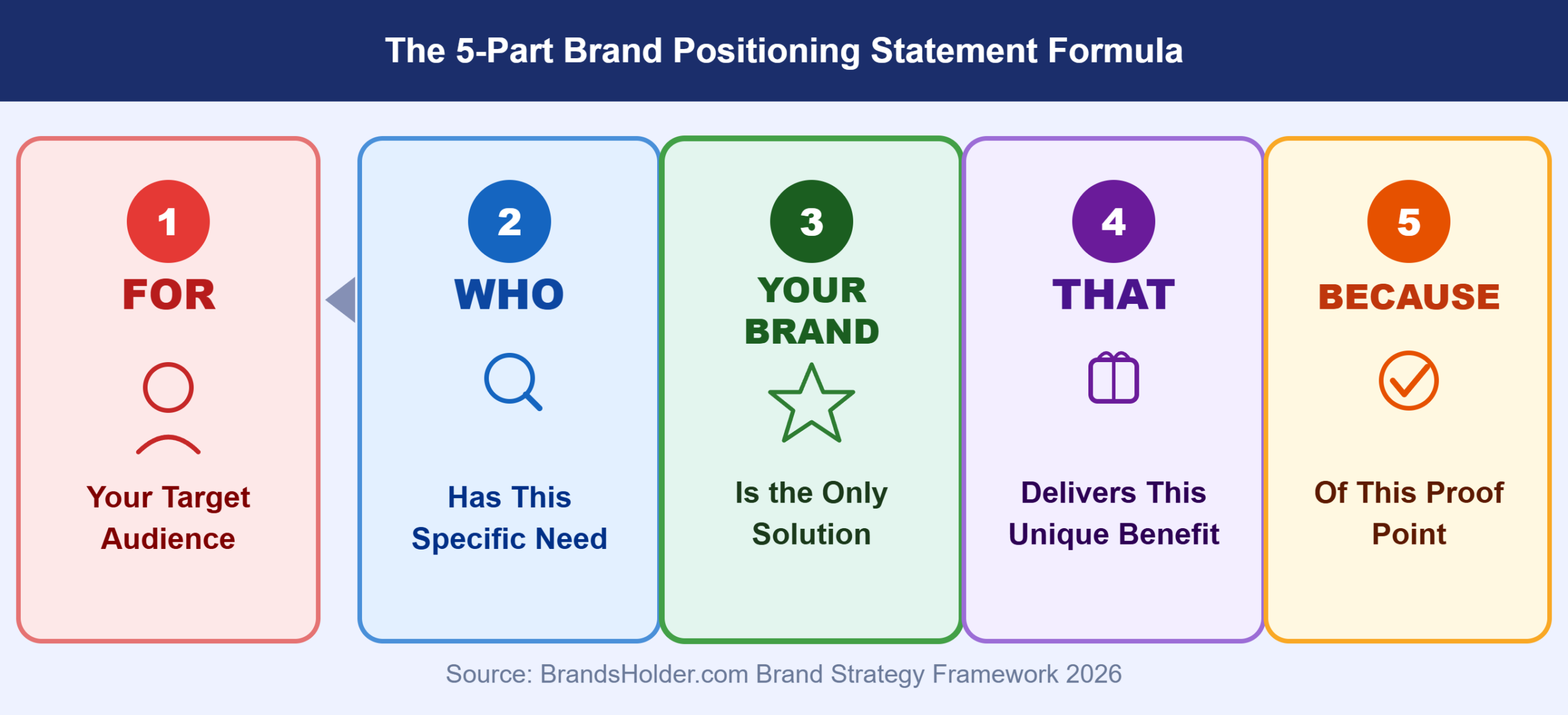
Every strong positioning statement regardless of industry, company size, or brand personality answers five fundamental questions. Here is the formula used by some of the world’s most successful brands, updated for 2026.
FOR [target audience]
WHO [has a specific need or problem]
[Brand Name] is the only [category descriptor]
THAT [unique benefit or point of difference]
BECAUSE [reason to believe / proof point]
Part 1 — FOR [Target Audience]
This is the hardest part for most businesses because specificity feels risky. Business owners worry: “If I name a specific audience, won’t I exclude potential customers?”
The answer is counterintuitive: the more specific your audience definition, the more powerfully your brand resonates with them and the more they refer others exactly like themselves to you.
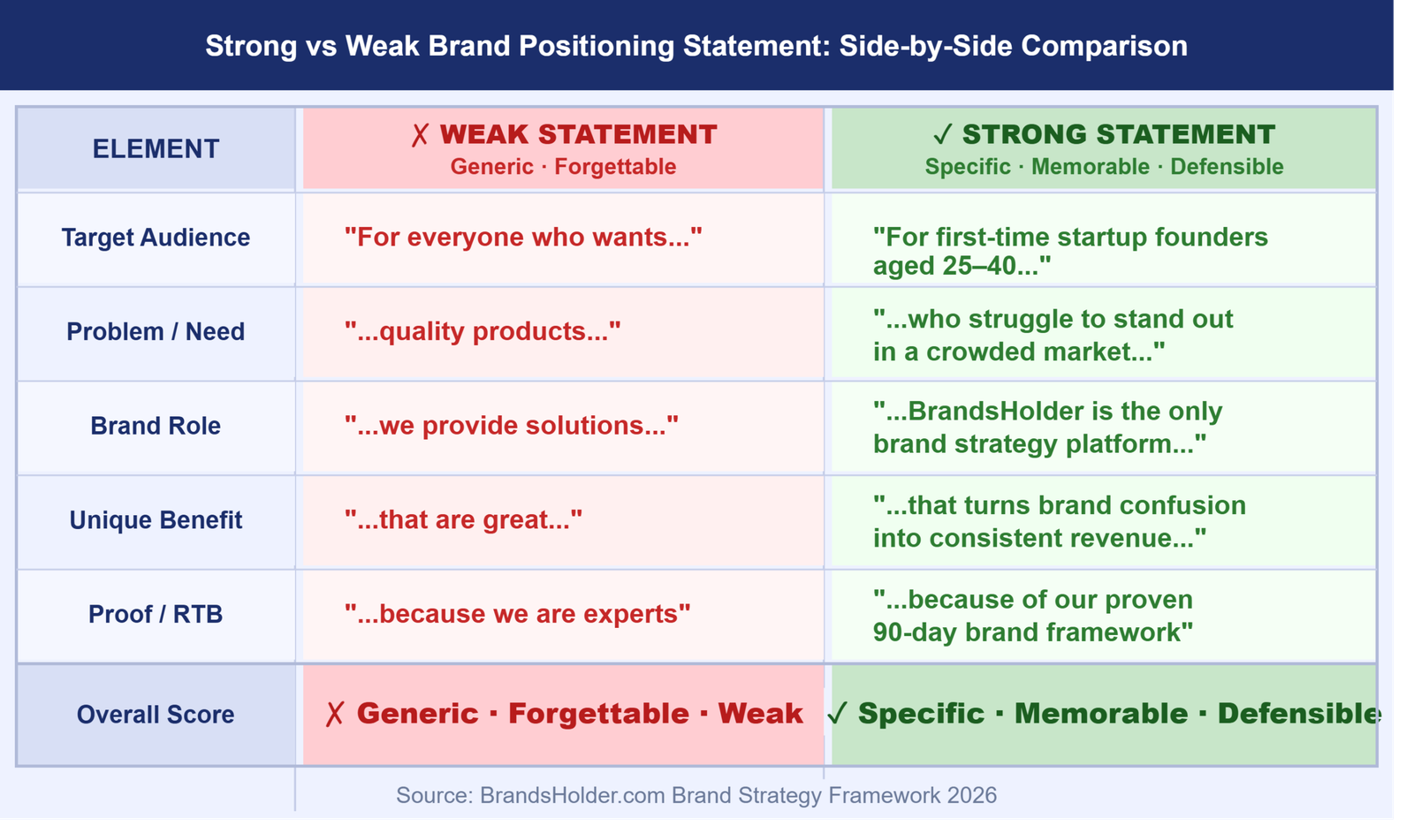
Weak: “For entrepreneurs…”
Strong: “For first-generation immigrant founders building product-based businesses in the US for the first time…”
The specificity of the strong version is what makes it powerful. If you are that founder, you feel immediately seen. That feeling of being seen is the foundation of brand loyalty.
Part 2 — WHO [Has a Specific Need or Problem]
This slot defines the pain point, desire, or situation that makes your brand relevant. It should describe a real, felt experience — not a general market category.
Weak: “…who want to grow their business…”
Strong: “…who have a great product but keep losing sales to less qualified competitors with better branding…”
The weak version describes a vague aspiration shared by every business. The strong version describes a specific, emotionally resonant situation that triggers immediate recognition.
Part 3 — [Brand Name] Is the Only [Category]
This is where you define your category and potentially create a new one. How you describe your category sets the competitive frame within which you want to be evaluated.
Apple did not say they made “computers.” They said they made “tools for creative professionals.” Nike did not say they made “athletic gear.” They said they made “performance equipment for athletes.” The category framing tells customers which alternatives to compare you against and which not to. Choose this carefully.
Part 4 — THAT [Unique Benefit]
This is the single most valuable thing customers get from choosing you over alternatives. Note that it is unique meaning it belongs to you and not to every competitor in your space.
Weak: “…that provides excellent customer service…”
Strong: “…that guarantees your brand strategy is complete within 90 days or we refund every cent…”
The strong version names a specific, verifiable, exclusive outcome. That is positioning.
Part 5 — BECAUSE [Reason to Believe]
This is the proof point — the evidence that makes your unique benefit claim credible rather than just another marketing promise.
In 2026, with AI assistants fact-checking claims in real time, the reason to believe has become more important than ever. Vague proof points are invisible to AI. Specific, verifiable claims backed by data, case studies, proprietary methods, or certifications are exactly what AI search models surface as credible sources.
Weak: “…because we have years of experience…”
Strong: “…because our proprietary Brand Clarity Framework has been used by 847 companies across 34 industries to increase brand recognition scores by an average of 64% in 90 days…”
Step-by-Step: How to Write Your Brand Positioning Statement
Now that you understand the formula, here is the exact process for writing your positioning statement. Follow these steps in order — skipping steps is the most common reason this exercise fails.
Step 1 — Conduct a Target Audience Deep-Dive
Before you write a single word, you need to know your audience with uncomfortable specificity. “Small business owners” is not an audience. It is a demographic category containing millions of people with wildly different needs and motivations.
Conduct customer interviews at minimum five to eight conversations with your best existing customers. Ask them:
- What were you trying to solve when you found us?
- What had you already tried before us? Why did it not work?
- What would you lose if we disappeared tomorrow?
- How would you describe what we do to a colleague?
The language your best customers use to describe your brand is the raw material for your positioning statement. Do not invent it discover it.
Step 2 — Map Your Competitive Landscape
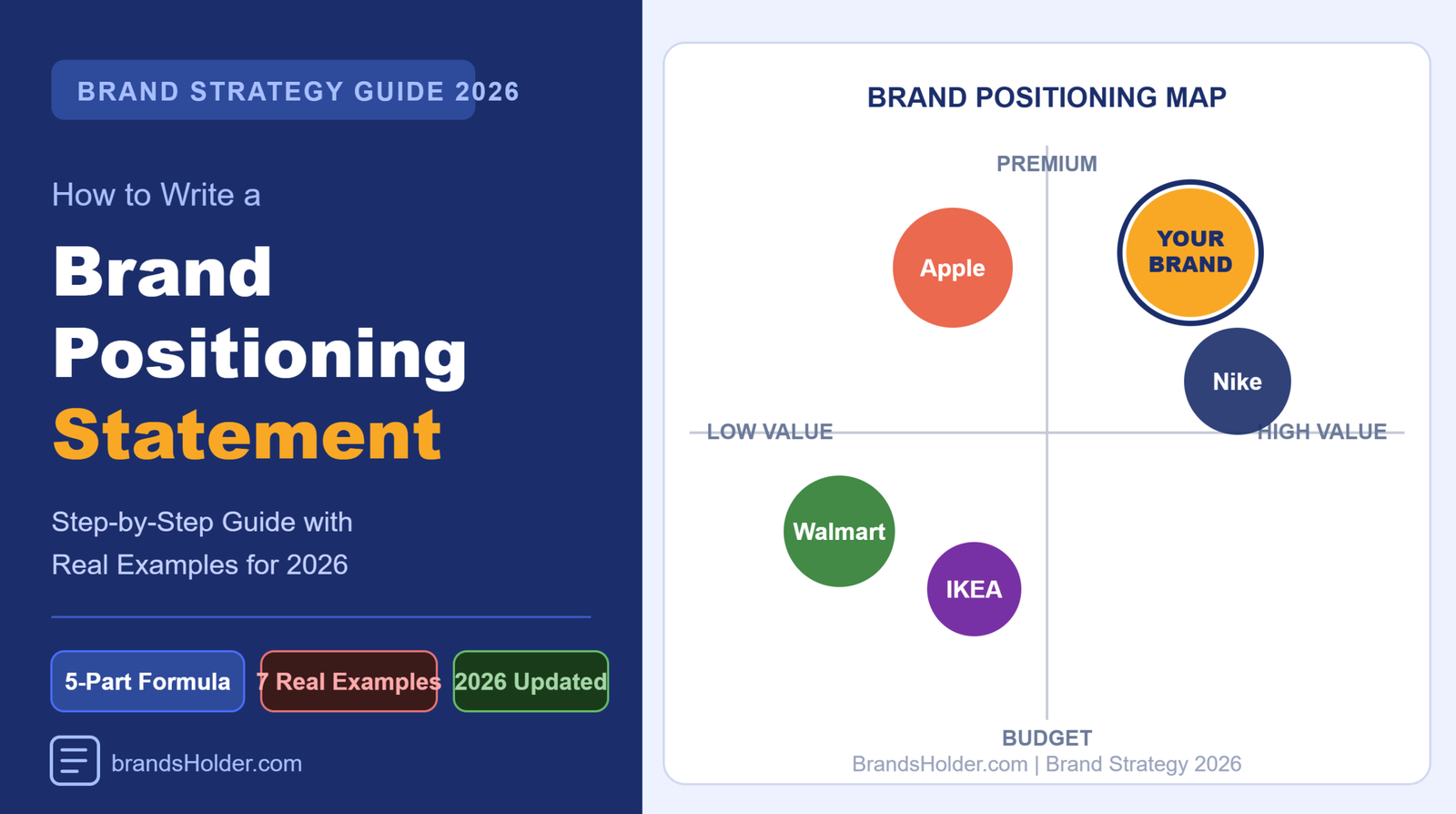
You cannot position your brand without knowing what positions are already occupied. Create a simple positioning map a two-axis grid that plots the key attributes customers use to differentiate in your category.
Common axes: price (low to high), quality (budget to premium), approach (traditional to innovative), audience (general to specialist), delivery (slow to fast).
Plot your main competitors on the map. Then look for the white space the combination of attributes no one else occupies but that your target customer genuinely values. That white space is your positioning opportunity.
Step 3 — Define Your True Point of Differentiation
Your point of differentiation must be three things simultaneously:
- True — you must be able to actually deliver it
- Valued — your target customer must genuinely care about it
- Ownable — competitors cannot immediately replicate it
Many businesses confuse features with differentiation. A feature is something you do. A differentiation is something only you do, in a way that matters to a specific customer, and that you can defend over time.
Step 4 — Draft Using the 5-Part Formula
With your audience research, competitive map, and differentiation defined, you now have all the raw material you need. Draft your positioning statement using the five-part formula.
Write at least three versions one for each of three different framing angles on your differentiation. Then stress-test each version against these questions:
- Does it name a specific audience?
- Does it describe a felt problem, not a generic category?
- Is the unique benefit actually unique and verifiable?
- Is the reason to believe specific, credible, and AI-discoverable?
- Can your entire team execute on the promises this statement makes?
Step 5 — Test, Validate, and Align Your Organization
A positioning statement written by marketing and unknown by operations is strategically worthless. Every customer-facing person needs to understand the positioning principles.
Test your draft with:
- Your sales team — do they find it easier to explain what you do?
- Existing customers — does it resonate with why they actually chose you?
- New prospects — does hearing your positioning make them more likely to engage?
Revise based on feedback. The goal is a statement so clear and resonant that it makes your marketing team’s jobs easier, your sales team more confident, and your customers more certain they have found the right fit.
7 Real-World Brand Positioning Statement Examples (Decoded)
Example 1 — Apple
For creative professionals who need technology that keeps pace with their imagination, Apple is the only tech company that designs both hardware and software as a unified system delivering tools that are as intuitive as they are powerful — because only Apple controls the full experience from chip to interface.
Why it works: The audience (creative professionals) is specific. The unique benefit (unified hardware-software system) is genuinely ownable. The proof (Apple controls the full stack) is verifiable.
Example 2 — Nike
For every athlete anyone with a body who wants to unlock their best physical performance, Nike is the only athletic brand that combines elite sports science with everyday accessibility, so ordinary people can train like champions because Nike partners directly with the world’s highest-performing athletes to build its products.
Why it works: The famous “if you have a body, you are an athlete” audience expansion makes Nike inclusive without being generic. The benefit bridges aspiration with accessibility.
Example 3 — Dove
For real women of all shapes, ages, and backgrounds who are tired of beauty marketing that makes them feel inadequate, Dove is the only personal care brand that celebrates authentic beauty rather than manufacturing an impossible standard because real women are the models, the voices, and the inspiration behind every Dove product.
Why it works: The positioning is built on a contrarian insight about the beauty industry itself, creating instant differentiation simply by refusing to do what every competitor does.
Example 4 — Airbnb
For adventurous travelers who want to experience destinations like locals rather than tourists, Airbnb is the only travel platform that offers accommodations in actual homes and neighborhoods so you live the culture rather than observe it from a hotel lobby because every listing is hosted by a real person with local knowledge to share.
Why it works: The “live like a local” positioning creates a category distinction from traditional hotels that cannot be easily replicated because it is structural hotels are hotels, not homes.
Example 5 — Slack
For modern teams whose work happens in real time across multiple projects and locations, Slack is the only business communication platform designed to eliminate email overload by organizing conversations by project and topic because integrating with the tools teams already use means information lives where work actually happens.
Why it works: The competitive frame (eliminating email overload) is clear and specific. The differentiator (topic-organized channels with integrations) is structural and hard to replicate.
Example 6 — Patagonia
For outdoor enthusiasts who believe that protecting wild places is inseparable from enjoying them, Patagonia is the only outdoor gear company that treats environmental activism as a core operating principle not a marketing add-on because 1% of every sale goes to environmental causes and we build gear designed to last decades, not seasons.
Why it works: The values-based differentiation is not just claimed — it is backed by a specific, verifiable, financial commitment that competitors cannot easily match.
Example 7 — Small Business Template (Apply to Your Brand)
For [specific audience with specific frustration], [Your Brand] is the only [category] that [specific unique outcome in a specific timeframe] because [specific, verifiable proof that no competitor can claim].
The 6 Types of Brand Positioning Strategy (And When to Use Each)
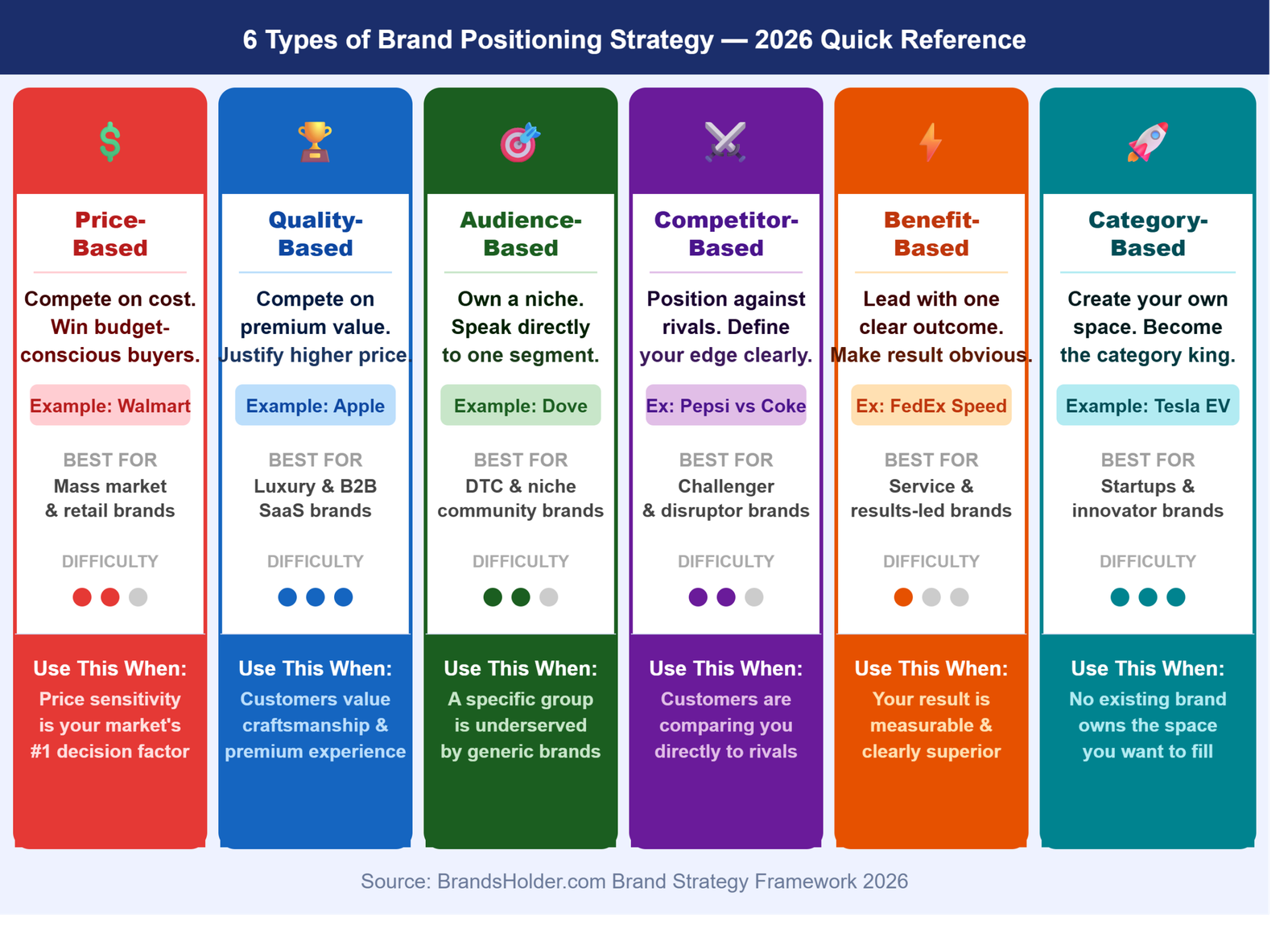
1. Price-Based Positioning
What it is: Building your position around being the most affordable option.
Classic example: Walmart — “Save Money. Live Better.”
When to use it: Only when your cost structure genuinely allows you to sustain the lowest price AND your audience is highly price-sensitive.
Warning: Most fragile positioning type. One competitor with deeper pockets erases it instantly.
2. Quality-Based Positioning
What it is: Positioning as the premium, superior-quality choice.
Classic example: Apple, Rolex, Rolls-Royce.
When to use it: When you can genuinely deliver and sustain premium quality AND your audience has both the means and motivation to pay for it.
3. Audience-Based Positioning
What it is: Positioning exclusively for a specific demographic, psychographic, or behavioral segment.
Classic example: Dove (real women), AARP (50+ adults), Nike Women.
When to use it: When a specific segment is underserved by existing generic options AND your brand can authentically serve that segment better than generalists.
4. Competitor-Based Positioning
What it is: Defining your brand by direct comparison to a specific competitor.
Classic example: Pepsi vs. Coke, Avis “We Try Harder” vs. Hertz.
When to use it: When the market leader is so dominant that positioning against them creates instant context AND you have a genuine superiority claim in a specific area.
5. Benefit-Based Positioning
What it is: Owning a specific functional or emotional benefit no competitor is clearly claiming.
Classic example: FedEx (overnight delivery), Volvo (safety), Crest (cavity prevention).
When to use it: When a specific benefit is highly valued by your audience AND no competitor has clearly and consistently claimed it first.
6. Category-Based Positioning (Blue Ocean)
What it is: Creating an entirely new category where you automatically become the leader.
Classic example: Tesla (luxury electric vehicles), Airbnb (home-sharing), LinkedIn (professional social network).
When to use it: When existing category definitions put you at a disadvantage AND you have evidence of unmet demand for a new way of framing the problem.
Common Brand Positioning Mistakes That Kill Otherwise Strong Brands
Mistake 1 — Positioning for everyone.
“Our brand is for anyone who wants quality” is not positioning. It is a refusal to make the hard strategic choice. The brands with the most loyal customers are almost always the ones with the most clearly defined specific audiences.
Mistake 2 — Copying the market leader.
If you position yourself the same way as the dominant brand in your category, you are asking customers to choose the lesser-known version of the same thing. Differentiation is the entire point.
Mistake 3 — Building positioning on features, not benefits.
Features are what your product does. Benefits are what your customer gets. Customers do not buy features they buy outcomes. Your positioning statement must be built on outcomes.
Mistake 4 — Changing positioning too frequently.
Brand positioning requires years of consistent reinforcement to take root in the minds of your audience. Changing your positioning every 12 to 18 months destroys the cumulative brand-building work you have already done.
Mistake 5 — Keeping positioning internal only.
A positioning statement that never influences your website copy, sales scripts, customer service language, or product design is not a positioning strategy it is an expensive exercise.
How Brand Positioning Connects to Your Complete Brand Strategy
A positioning statement is one component of a complete brand strategy framework. If your brand strategy is the architecture blueprint, your positioning statement is the foundation everything else is built on.
Your brand identity — the visual and verbal expression of your brand should make your positioning tangible. Your brand story should dramatize your positioning for emotional impact. Your brand guidelines should encode your positioning into rules every team member can follow consistently.
The brands that successfully build genuine brand trust are the ones for which positioning is not a document, it is an organizational operating principle that shows up in every hiring decision, every product feature, every customer service interaction, and every piece of marketing content.
If your brand is struggling to stand out from competitors, the problem is almost always one of execution rather than strategy: the positioning exists on paper but has not been translated into consistent operational behavior.
Brand Positioning in the Age of AI Search (2026 Update)
Here is the 2026-specific insight most brand positioning guides miss: AI-powered search engines are now the first point of contact between many potential customers and your brand.
When a prospect asks ChatGPT, Perplexity, or Google AI Overview “who is the best [category] brand for [specific audience]?”, the AI pulls from publicly available information about your brand and synthesizes it into a response.
If your positioning is clear, consistent, and well-documented across your website, reviews, press coverage, and social channels, AI assistants will accurately represent that positioning. If it is vague, inconsistent, or absent, AI will either omit you entirely or describe your brand as generic.
Your positioning statement is not just a strategic document anymore, it is an AI discoverability asset. The specificity that makes great positioning work for human audiences is exactly the same specificity that makes it machine-readable and AI-recommendable.
This is why investing in clear positioning today pays compound dividends in 2026 and beyond. For more on how AI search is reshaping brand visibility, see our full guide on Google SGE and brand strategy.
Conclusion
A brand positioning statement is not a branding exercise, it is a business growth decision. When you clearly define who you serve, what problem you solve, why you are different, and why anyone should believe it, every other part of your business gets easier. Your marketing becomes sharper. Your sales conversations become shorter. Your customers become advocates because they finally understand exactly what you stand for.
In 2026, with AI assistants scanning your brand across the web and presenting summaries to potential customers before you ever get a chance to speak, the clarity of your positioning is no longer just a marketing advantage it is a discoverability requirement. Vague brands are invisible brands.
At BrandsHolder, we believe that every business from first-time founders to scaling enterprises deserves a brand position that is impossible to ignore. If you are ready to stop competing on price and start owning your market space, explore our complete brand strategy resources at BrandsHolder and start building the positioning that your business has always deserved.
FAQs
Q1: What is the difference between a brand positioning statement and a value proposition?
A positioning statement defines your competitive space relative to alternatives. A value proposition focuses on customer benefit. One is internal strategy; the other is external communication.
Q2: How long should a brand positioning statement be?
Two to four sentences. If it needs more to explain, it is not specific enough yet.
Q3: How often should you update it?
Review annually. Change only when the market shifts significantly most brands update every three to five years.
Q4: Can small businesses use this too?
Yes, and they benefit most. Specific positioning lets small brands outperform larger generalists with bigger budgets.
Q5: What is the biggest mistake in brand positioning?
Trying to appeal to everyone. Generic positioning is invisible positioning.
Q6: How does positioning affect SEO?
Clear positioning creates content consistency that search engines reward. In AI search, your positioning is literally what AI tools use to describe and recommend your brand.