Most businesses treat brand strategy as a logo and a color palette. Then they wonder why Google keeps pulling their pages out of the index, why their traffic flatlines, and why customers cannot seem to remember them after one visit.
Brand strategy is not a design exercise. It is the structural foundation that determines whether Google trusts your website enough to index it, rank it, and show it to people who are actively searching for what you offer.
In 2026, after Google’s Helpful Content updates and the rise of AI-driven search, brand signals have become one of the most important and most overlooked ranking factors in existence. This guide covers everything: what brand strategy actually is, why it matters for SEO, what the five core pillars are, and exactly how to rebuild Google’s trust if you have lost it.
What Is Brand Strategy?
Brand strategy is a long-term plan that defines how your business presents itself to the world, its purpose, its voice, its visual identity, and its positioning in the market. A strong brand strategy ensures that every piece of content, every social post, and every page on your website tells a consistent, authoritative story that both humans and search engines can understand and trust.
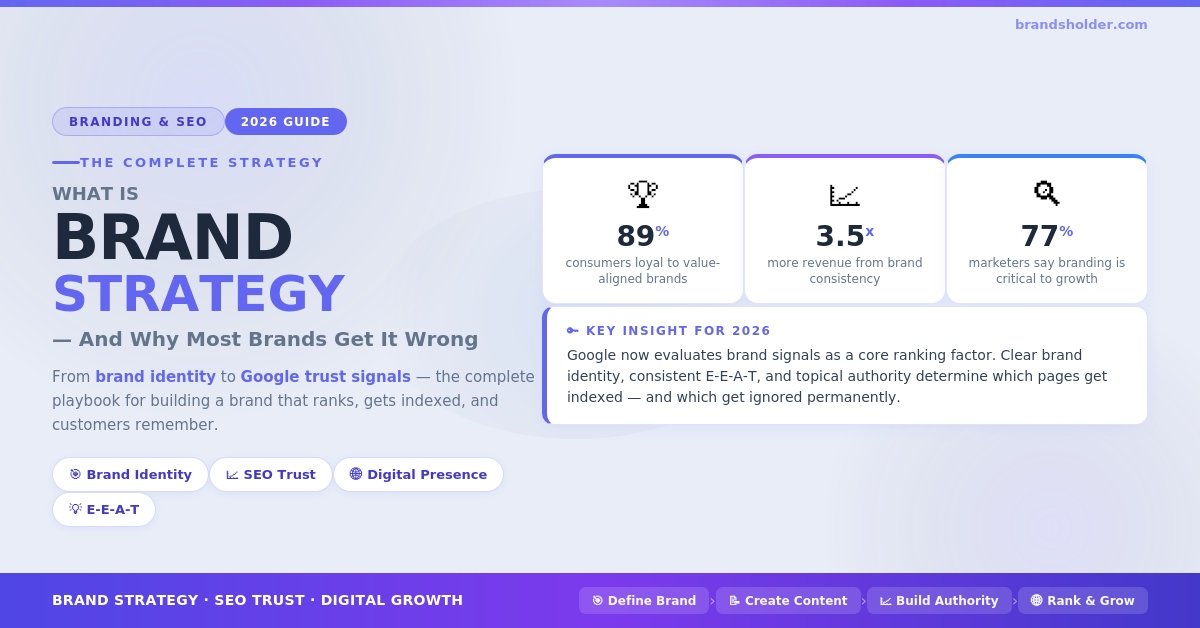
According to Lucidpress, consistent brand presentation across all platforms increases revenue by up to 33%. According to Edelman’s Trust Barometer, 81% of consumers say they need to trust a brand before they make a purchase. And according to Google’s own quality guidelines, brand signals including mentions, backlinks, author credentials, and topical consistency directly influence how pages are evaluated for search ranking.
This is not abstract. This is the mechanism behind why some websites get indexed in hours and others sit ignored for months.
Why Brand Strategy and SEO Are the Same Thing in 2026
Before we get into the five pillars, it is worth understanding why brand strategy and SEO have merged into a single discipline.
Google’s 2024 and 2025 core updates, including the Helpful Content System, made one thing unmistakably clear: generic, anonymous, interchangeable content loses rankings. What wins is content that demonstrates who wrote it, why they are qualified to write it, and whether the brand behind it has a consistent, verifiable presence on the web.
This is Google’s E-E-A-T framework in action, Experience, Expertise, Authoritativeness, and Trustworthiness. And every single component of E-E-A-T is a brand signal.
If your website lost indexing recently, the problem almost certainly traces back to one of these brand failures. We cover the indexing issue specifically in the second half of this guide.
| Brand Signal | What Google Looks For | Impact on Indexing |
|---|---|---|
| Author credentials | Named author with verifiable expertise, bio page, social links | High |
| Consistent publishing | Regular content updates showing active, live website | High |
| Brand mentions online | Citations, references, and links from other websites | High |
| Topical consistency | Content that stays within a defined subject area | Medium-High |
| Visual + voice consistency | Same tone, style, and identity across all pages | Medium |
| Internal link structure | Clear content hierarchy connecting all pages | Medium-High |
| Schema markup | Structured data confirming what the brand is and does | Medium |
| Social proof | Reviews, testimonials, case studies with real specifics | Medium |
The 5 Core Pillars of Brand Strategy
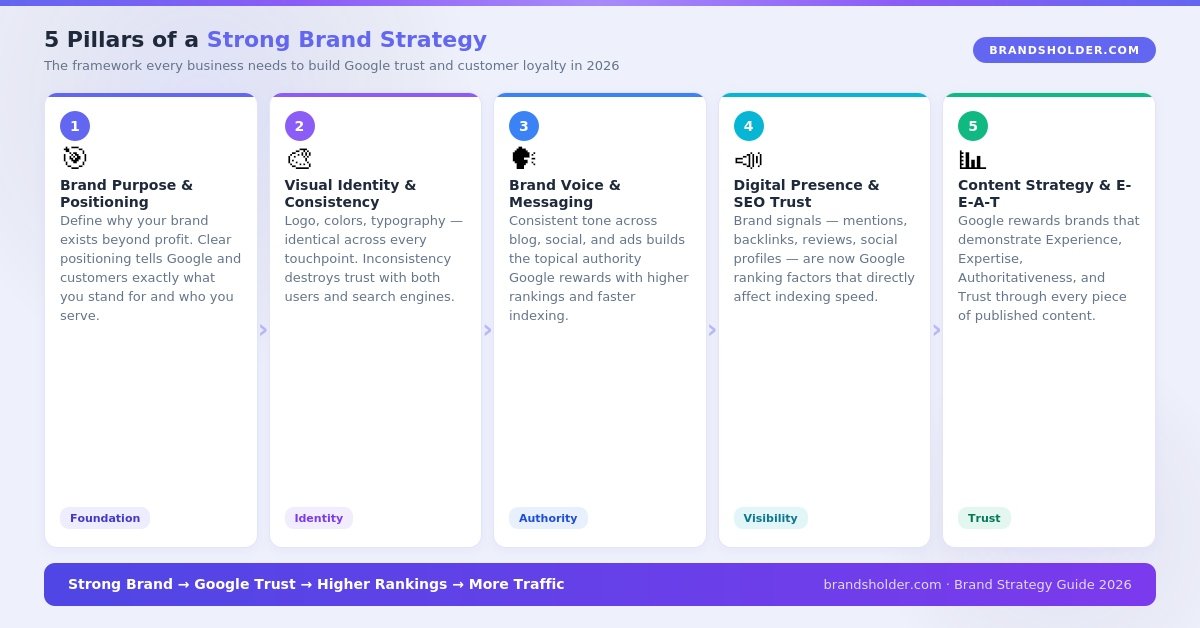
Pillar 1 — Brand Purpose and Positioning
Every strong brand starts with a clear answer to one question: why does this business exist beyond making money?
Brand purpose is not a mission statement you frame on a wall. It is the specific problem you solve for a specific group of people, stated so clearly that both a first-time visitor and a search engine can understand it within ten seconds.
Positioning is the related concept of how you compare to alternatives. Are you the most affordable option? The most expert? The most niche? The most innovative? Trying to be everything to everyone is the fastest path to meaning nothing to Google, because Google cannot place you in any clear category, and neither can your potential customers.
What to do right now: Write one sentence that completes this structure, “[Brand name] helps [specific audience] achieve [specific outcome] by [specific method].” Post that sentence on your homepage, your about page, and your author bio. This single act of clarity improves E-E-A-T signals more than most technical SEO changes.
For a deeper look at how Google evaluates content quality, read our guide on how Google’s Helpful Content System actually scores your website.
Pillar 2 — Visual Identity and Consistency
Your visual identity logo, color palette, typography, image style, needs to be identical across every surface where your brand appears. Your website, your social profiles, your author images, your featured images, your email newsletters.
Inconsistency damages trust. When a visitor sees a completely different visual style between your Facebook page and your website, the subconscious message is that this is not a serious business. When Google crawls your site and sees inconsistent branding, it has less confidence in the entity behind the content.
Google’s Entity-Based Search, which has been developing since 2012 and has fully matured in 2025 and 2026, works by understanding what your brand is as a cohesive entity. Consistent visual and informational signals across the web make your brand easier for Google to understand, categorize, and trust.
What to do right now: Run a visual audit. Open your website, your LinkedIn, your Facebook, and your Google Business Profile simultaneously. Are the logo, the colors, and the description consistent? Fix any that are not.
Pillar 3 — Brand Voice and Messaging
Your brand voice is how you write, what words you choose, what topics you cover, and what tone you maintain across everything you publish.
For SEO specifically, consistent brand voice creates topical authority the quality of being recognized by Google as the go-to source for a specific subject. Brandsholder covers digital marketing, branding, and business strategy. Every article published in those areas contributes to the topical authority signal. Every article published outside those areas dilutes it.
This is one of the quieter reasons websites lose indexing. A site that covers ten different topics in an inconsistent voice looks to Google like a content farm rather than a genuine expert resource. The Helpful Content System specifically penalizes this pattern.
What to do right now: Audit your last 20 published posts. Draw a clear line between what stays, content that directly serves your core audience on your core topics and what should be reconsidered. You do not need to delete content, but you do need to be honest about what your site is actually about.
For guidance on how AI tools can help maintain content consistency, read our post on how to train an AI chatbot on your own business content.
Pillar 4 — Digital Presence and SEO Trust Signals
This is where brand strategy and SEO most visibly overlap.
Your digital presence is the sum of every external signal that tells Google your brand is real, trusted, and active. This includes:
Backlinks from relevant websites in your industry. Social media profiles that are complete, consistent, and regularly updated. Google Business Profile if you serve a local area. Brand mentions in articles, podcasts, and forums even without a link. Reviews and testimonials on Google, Trustpilot, or industry platforms.
In 2026, Google is increasingly using these off-page brand signals to determine which pages deserve to be indexed and ranked. Websites with zero external validation — no backlinks, no mentions, no social activity are treated as unverified. Their pages may be crawled but are frequently not indexed, or are indexed and then quietly dropped.
This is exactly what happens when Google says a page is “discovered but currently not indexed.” The page exists. Google knows it exists. But Google has not yet decided it deserves to be in the index. Brand signals are often the deciding factor.
For a technical breakdown of why pages lose indexing and how to recover, our article on negative SEO attacks and how to protect your website covers the external threat side of this issue.
Pillar 5 — Content Strategy and E-E-A-T
The final pillar is where everything comes together. Your content strategy is the publishing plan that communicates your brand’s expertise, demonstrates your experience, builds topical authority, and gives Google fresh signals to evaluate on a regular basis.
A content strategy aligned with E-E-A-T includes: named authors with verifiable credentials on every post, original research or data that cannot be found elsewhere, expert quotes and external citations that validate claims, specific case studies and real examples rather than generic advice, and consistent publication frequency that tells Google this website is actively maintained.
This is the difference between content that gets indexed the same day it is published and content that sits in Google’s crawl queue for weeks before being quietly ignored.
For a detailed breakdown of what Google checks before ranking content, read our EEAT Checklist: 27 Things Google Checks Before Ranking Your Content.
Why Google De-indexed Your Pages And the Fix
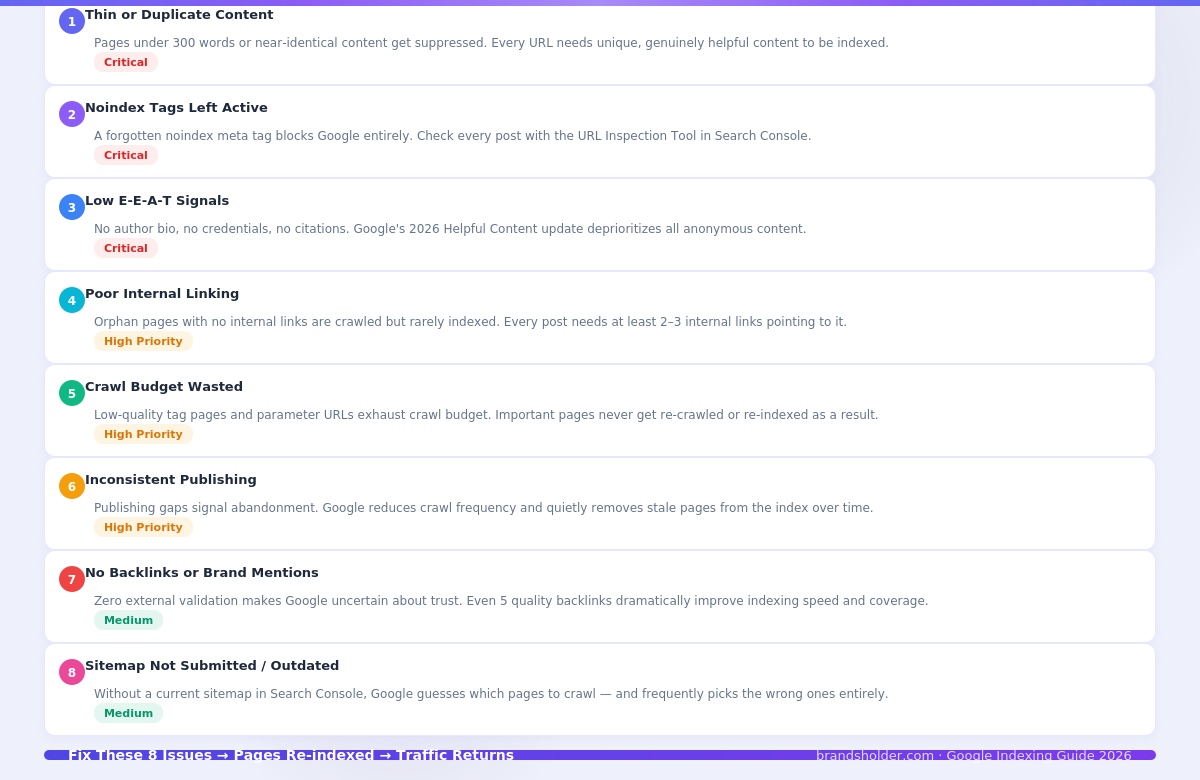
If your website has lost indexing on most of its pages with only the homepage remaining visible in Google this section is written specifically for your situation.
This pattern is common and recoverable. Here is what almost always causes it and what fixes each issue.
- Thin or duplicate content is the most frequent cause. Pages under 300 words, pages that repeat the same content with only small variations, or pages that use AI-generated text without meaningful human editing all trigger Google’s quality filters. The fix is to audit every page using Screaming Frog or Ahrefs, identify the thin ones, and either significantly expand them or consolidate them with stronger pages using 301 redirects.
- Noindex tags left active can happen after a site migration, a theme change, or a plugin update. A single noindex tag in your robots.txt or on individual page meta tags will block Google regardless of how good the content is. Check every page using the URL Inspection Tool in Google Search Console.
- Low E-E-A-T signals across the site mean Google has low confidence in the source. If most of your posts have no named author, no author bio, and no external credentials, add them. Even a simple author bio linking to a LinkedIn profile significantly improves Google’s trust evaluation.
- Poor internal linking means Google’s crawlers cannot efficiently navigate from your indexed pages to your other content. Every post should link to at least two or three other relevant posts on your site. Your homepage and category pages should link to your most important content explicitly.
- Crawl budget exhausted by low-quality URLs means Google spends its allocated crawling time on tag pages, parameter URLs, and pagination rather than on your actual content. Use your robots.txt to block crawling of low-value URL patterns and use canonical tags to consolidate similar pages.
- Inconsistent publishing history signals an abandoned site. If you published 50 posts in January and nothing for four months, Google reduces its crawl frequency and may remove stale pages from the index. Commit to a minimum of two posts per week and maintain it without gaps.
- No backlinks or brand mentions means Google has no external validation of your website’s legitimacy. Even five quality backlinks from relevant websites in your industry can dramatically improve how quickly new pages get indexed. Guest posts, resource mentions, and industry directories are the fastest legitimate ways to build them.
- Sitemap not submitted or outdated means Google is guessing what to crawl. Submit your sitemap to Google Search Console, verify it is updating automatically after each new post, and request indexing for your most important pages manually using the URL Inspection Tool.
For step-by-step guidance on diagnosing traffic and indexing problems, our post on Google Search Console vs Google Analytics which data actually matters will help you read the right signals.
How to Rebuild Google’s Trust — A 30-Day Plan
Trust recovery is not instant, but it is predictable. Google responds to consistent positive signals over time. Here is a practical 30-day sequence:
Week 1 — Fix the foundation. Audit every page for noindex tags, thin content, and missing author information. Fix the crawl issues first they block everything else.
Week 2 — Strengthen internal linking. Go through your existing published posts and add internal links to your best content. Every page on your site should be reachable within three clicks from the homepage.
Week 3 — Publish two strong posts. Not thin, not generic. Each one should be a minimum of 1,500 words, have a named author with a bio, include at least two external citations from authoritative sources, and contain at least three internal links to other pages on your site.
Week 4 — Build one external signal. Reach out to one relevant website in your industry for a guest post, a quote contribution, or a resource mention. A single quality backlink
from a relevant domain sends a strong trust signal that compounds over time.
After 30 days, use the URL Inspection Tool in Google Search Console to request indexing on your five most important pages. Monitor the Coverage report weekly for improvements.
Brand Strategy vs Marketing Strategy, The Difference That Matters
Many business owners confuse these two. Understanding the difference prevents a common and costly mistake.
Brand strategy defines who you are. It is the long-term foundation: your values, your positioning, your identity, and your voice. It changes slowly and deliberately. Marketing strategy defines how you reach people. It is the shorter-term plan: which channels, which campaigns, which audiences, which messaging. It evolves quickly based on performance data.
The mistake is investing heavily in marketing strategy, running ads, posting on social media, doing outreach, before the brand strategy foundation is solid. Marketing amplifies what already exists. If what exists is inconsistent, unclear, or untrustworthy, marketing simply spreads that inconsistency further and faster.
Build the brand foundation first. The marketing results that follow are measurably stronger.
For a practical look at how marketing strategy decisions affect business outcomes, read our article on why businesses need a full-service digital marketing agency in 2026.
Final Thought
Brand strategy in 2026 is not a marketing nicety. It is the structural backbone of your website’s relationship with Google. Every pillar — purpose, visual identity, voice, digital presence, and content contributes to the trust signal that determines whether Google indexes your pages, ranks your content, and sends you traffic.
If your pages have been removed from Google’s index, the fastest path back is not a technical hack. It is consistent, high-quality brand signals published regularly over time. That is what Google is designed to reward, and it is what this guide is designed to help you build.
Frequently Asked Questions
What is the simplest definition of brand strategy?
Brand strategy is the long-term plan for how your business presents itself to the world what it stands for, what it looks like, how it speaks, and how it builds trust with both customers and search engines over time.
How does brand strategy affect Google indexing?
Google uses brand signals author credentials, consistent publishing, external mentions, topical consistency, and structured data as indicators of trustworthiness. Websites with weak brand signals often see pages de-indexed or excluded from search results even when the content itself is technically sound.
How long does it take to rebuild Google’s trust after losing indexing?
Typically four to twelve weeks of consistent work. The speed depends on how quickly you fix technical issues, how regularly you publish quality content, and how fast you build external validation signals like backlinks and brand mentions.
Is brand strategy only for large companies?
No. Small businesses and solo operators benefit more from a clear brand strategy than large companies do, because they have fewer resources and cannot afford to waste them on inconsistent messaging. A clearly defined brand makes every marketing decision easier and every content investment more effective.
What is the difference between brand identity and brand strategy?
Brand identity is one component of brand strategy. It covers the visual elements logo, colors, typography. Brand strategy is the broader system that includes identity, purpose, voice, positioning, digital presence, and content approach.
How do I know if my brand strategy is working?
The clearest indicators are: pages getting indexed faster after publishing, Google Search Console showing increasing impressions, returning visitor rates improving in Google Analytics, and brand name searches appearing in your Search Console query data. These all signal growing Google trust.