Choosing between a SaaS free trial and a freemium model is one of the biggest growth decisions for software businesses in 2026. While free trials often generate higher short-term paid conversion rates, freemium models can build larger user bases and long-term customer relationships. The right choice depends on your product complexity, target audience, onboarding experience, and business goals. This guide compares both models, explores real-world use cases, and shares practical strategies to help SaaS companies increase paid conversions while improving customer satisfaction.
Key Takeaways
| Factor | Free Trial | Freemium |
|---|---|---|
| Best For | Products with quick value demonstration | Products that benefit from long-term engagement |
| Conversion Speed | Faster | Slower but steady |
| User Acquisition | Moderate | High |
| Customer Commitment | Higher | Lower initially |
| Ideal Business Model | B2B SaaS, enterprise software | Product-led growth and collaboration tools |
| Main Challenge | Trial expiration before value realization | Converting free users into paying customers |
Understanding SaaS Free Trial vs Freemium
Choosing the right acquisition model affects revenue, customer experience, and long-term business growth. Many SaaS founders compare these strategies before launching a new product or improving an existing one. Understanding their differences helps businesses make smarter decisions that align with user expectations and growth goals.
What Is a SaaS Free Trial?
A SaaS free trial gives users complete or limited product access for a fixed period before requiring payment. The goal is to let potential customers experience the product’s value before making a purchase decision. A successful trial quickly demonstrates meaningful value through guided product experiences. Businesses commonly offer 7-day, 14-day, or 30-day trial periods depending on product complexity.
What Is a Freemium Model?
A freemium model provides permanent access to basic features while charging users for advanced capabilities. This approach lowers the entry barrier and encourages widespread product adoption among different customer segments. Users upgrade naturally when premium features solve increasingly important business challenges. Many successful SaaS companies use freemium to build brand awareness and long-term customer loyalty.
Core Differences at a Glance
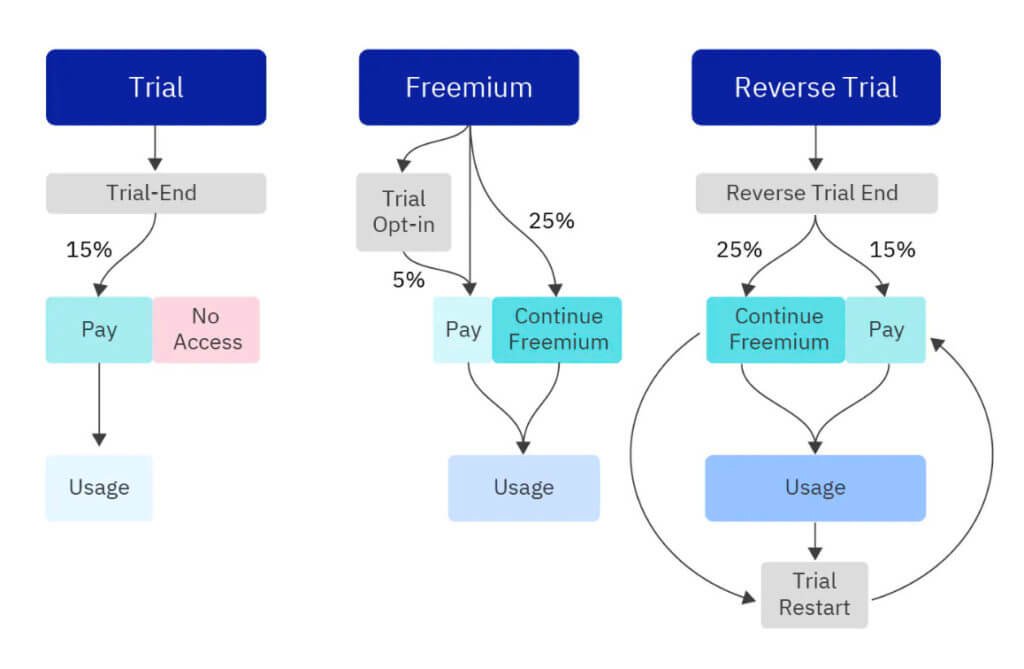
Although both models attract new users, their objectives and customer journeys differ significantly. Free trials create urgency through limited access, while freemium encourages continuous product engagement over time. Each strategy influences customer behavior through completely different psychological purchasing triggers.
| Feature | Free Trial | Freemium |
|---|---|---|
| Access Duration | Limited | Unlimited |
| Features | Full or nearly full | Limited |
| Upgrade Trigger | Trial expiration | Feature limitations |
| Primary Goal | Fast conversions | Large user acquisition |
| User Commitment | Higher | Lower |
| Best For | High-value SaaS | PLG and collaboration software |
How Each Model Impacts Paid Conversions
Both acquisition models can drive revenue when supported by strong onboarding and customer success efforts. However, conversion rates depend on product quality, user engagement, and how quickly customers experience value. Businesses should evaluate conversion alongside retention, expansion revenue, and customer lifetime value rather than focusing only on sign-ups.
Free Trial vs Freemium Conversion Benchmarks
Industry studies consistently show that free trials generally convert a higher percentage of users into paying customers. Since trial users know access will expire, they are more motivated to explore important features and complete onboarding. Limited availability often encourages users to evaluate products with greater urgency. However, conversion success depends on delivering clear value before the trial ends.
User Psychology Behind Each Model
Customer behavior changes depending on the model they experience first. Trial users often feel motivated by deadlines, while freemium users value flexibility and reduced financial risk. Human decisions frequently become stronger when urgency combines with meaningful product benefits. Understanding these psychological patterns helps businesses design better onboarding journeys and upgrade campaigns.
Factors That Influence Conversion Rates
Several factors determine whether users eventually become paying customers regardless of the chosen strategy.
- Product onboarding quality
- Time-to-value
- Feature adoption
- Customer support responsiveness
- Personalized upgrade messaging
- Product Qualified Lead (PQL) tracking
- User engagement analytics
Improving these areas usually produces better results than simply changing pricing models.
Pros and Cons of Free Trials
Free trials remain popular because they allow users to experience premium functionality without immediate financial commitment. This strategy works especially well when customers can understand the product’s value within a short period. Businesses must carefully balance trial length, feature availability, and onboarding support to maximize conversions.
Advantages
One major advantage of free trials is that they attract users with genuine purchase intent. Since visitors know the evaluation period is temporary, they often invest more time exploring advanced capabilities. Qualified prospects frequently convert after experiencing measurable improvements during their trial. This approach also helps sales teams identify highly engaged leads more efficiently.
Limitations
Despite their strengths, free trials are not suitable for every SaaS product. Complex platforms sometimes require longer learning periods before users recognize meaningful value. Poor onboarding often causes promising users to abandon products before subscribing. Short trial periods without effective guidance can reduce conversions and increase acquisition costs.
Pros and Cons of Freemium
Freemium continues to power many successful product-led growth businesses because it encourages widespread adoption with minimal barriers. Users can explore essential features without worrying about deadlines or payment information. When executed correctly, this model builds trust while creating opportunities for long-term monetization.
Advantages
Freemium attracts a larger audience because users can start using the software immediately without financial commitment. Over time, satisfied customers naturally require premium features as their needs become more advanced. Continuous product usage gradually builds confidence before important purchasing decisions occur. This model also generates valuable user feedback that helps improve future product development.
Challenges
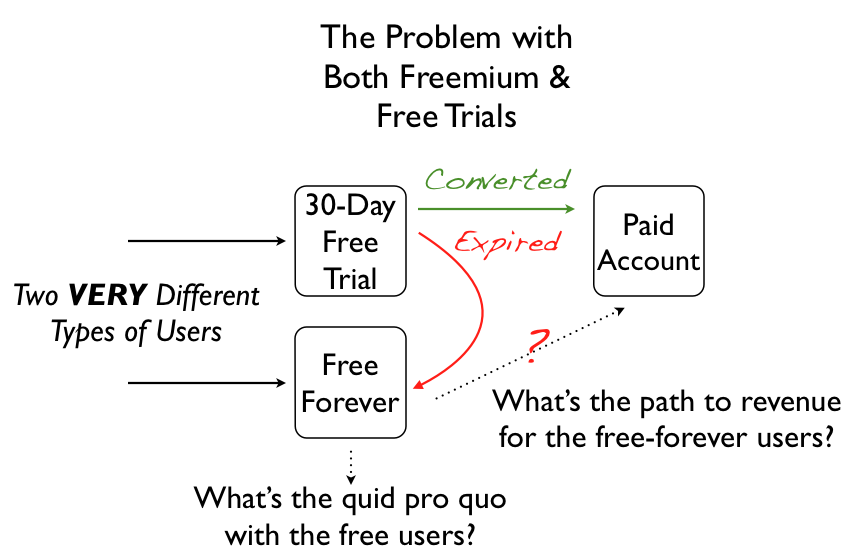
Freemium businesses often struggle to convert a large percentage of free users into paying customers. Some customers remain satisfied with basic functionality and never feel the need to upgrade. Weak feature differentiation significantly reduces motivation for premium subscription upgrades. Successful freemium strategies require thoughtful feature limits that encourage upgrades without frustrating users.
Choosing the Best SaaS Model
There is no universal winner when comparing free trials and freemium models. The right choice depends on your product, target audience, sales cycle, and customer behavior. Companies that understand their users’ needs usually build stronger conversion strategies and achieve sustainable growth.
Best for B2B SaaS
B2B software often performs better with a free trial because business buyers want to evaluate premium features before purchasing. Decision-makers also prefer testing integrations, security, reporting, and collaboration tools during the evaluation period. Business customers usually purchase faster after seeing measurable operational improvements firsthand. A guided onboarding process combined with product demonstrations can further increase trial-to-paid conversions.
Best for B2C SaaS
Consumer-focused SaaS products generally benefit from a freemium approach because users prefer exploring software without payment commitments. Social apps, design tools, note-taking platforms, and productivity software often grow rapidly through word-of-mouth recommendations. Easy product access encourages sharing and faster community-driven user growth naturally. Premium upgrades become attractive as users require more storage, features, or customization.
Best for AI and Product-Led Growth SaaS
Modern AI-powered SaaS products often combine both models to maximize adoption and revenue. Users may receive permanent access to basic AI features while unlocking advanced automation through a premium subscription. Hybrid strategies balance customer acquisition with predictable recurring revenue growth effectively. This approach is increasingly common among product-led growth companies in 2026.
Hybrid Free Trial + Freemium Approaches
Many successful SaaS companies no longer choose only one model. Instead, they allow users to start with a free plan and temporarily unlock premium features through a limited trial. This helps customers experience advanced capabilities before deciding whether to upgrade permanently.
SaaS Trial Strategy to Convert Free Users to Paid
Getting users to sign up is only the beginning of the customer journey. The real challenge is helping them experience value quickly and confidently. A thoughtful onboarding process can dramatically improve conversion rates while reducing customer frustration.
Optimize Onboarding
First impressions strongly influence whether users continue using your software. Interactive tutorials, onboarding checklists, and personalized welcome messages help users reach meaningful outcomes faster. Simple onboarding experiences reduce confusion and improve customer satisfaction immediately. Removing unnecessary steps also decreases user drop-offs during the first session.
Deliver Value Quickly
Customers should experience the product’s core benefit as early as possible. If users struggle to understand the software, they are less likely to subscribe after the evaluation period. Fast value delivery builds trust before pricing discussions become important. Focus on reducing time-to-value instead of adding unnecessary onboarding complexity.
Use Product Qualified Leads (PQLs)
Instead of treating every free user equally, identify those demonstrating buying intent through product behavior. Frequent logins, feature adoption, team invitations, and usage patterns often indicate strong purchase potential. Behavioral data reveals stronger purchase intent than simple registration numbers alone. Sales and customer success teams can prioritize these high-value prospects.
Personalized Upgrade Prompts
Generic upgrade messages rarely produce excellent results. Tailor upgrade recommendations based on each customer’s product usage and business needs. Personalized messaging makes premium features feel more relevant and valuable.
AI-Powered Engagement
Artificial intelligence is transforming SaaS onboarding in 2026. AI assistants can recommend features, answer questions instantly, and guide users through complex workflows. Intelligent assistance improves engagement while reducing customer support workload considerably. Personalized AI experiences also increase product adoption and long-term retention.
Common Mistakes That Hurt SaaS Conversions
Even excellent software can struggle if the acquisition strategy creates friction. Many businesses lose potential customers because they overlook basic conversion optimization principles. Avoiding these mistakes can improve revenue without increasing marketing spend.
Poor Feature Gating
Premium features should encourage upgrades rather than frustrate users. Locking too many basic functions often causes new users to abandon the product completely. Balanced feature access creates curiosity instead of customer disappointment.
Weak Onboarding
Complicated onboarding reduces product adoption and decreases user confidence. Customers who cannot understand the software quickly rarely become loyal subscribers. Investing in educational resources and product guidance improves the overall experience.
No Usage-Based Upgrade Triggers
Upgrade prompts should appear when users naturally reach product limitations. Random pop-ups interrupt workflows and reduce trust. Usage-based recommendations feel more helpful and relevant to customers.
Ignoring Customer Success
Customer success teams play a major role in increasing paid conversions. Proactive communication, educational webinars, and personalized recommendations help customers realize the product’s full value. Happy users are significantly more likely to upgrade and remain loyal.
Free Trial vs Freemium Comparison Summary
Both strategies offer unique advantages depending on your business goals. Comparing them side by side makes selecting the right model much easier.
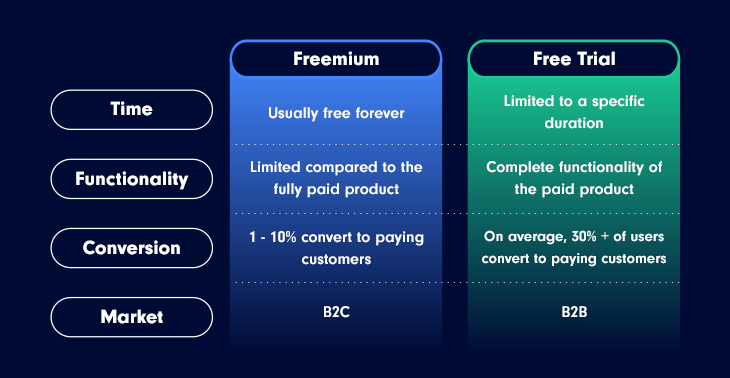
| Criteria | Free Trial | Freemium |
|---|---|---|
| Primary Goal | Fast paid conversions | User acquisition and long-term growth |
| Best Audience | B2B and enterprise | B2C and product-led growth |
| Revenue Speed | Faster | Gradual |
| User Volume | Moderate | High |
| Retention Potential | High with good onboarding | High with continuous engagement |
| Main Challenge | Short evaluation window | Low free-to-paid conversion |
| Best Use Case | Premium software | Collaboration and productivity tools |
Final Verdict
For most B2B SaaS businesses, a well-designed free trial generally delivers higher paid conversion rates because users experience premium value before making a purchase decision. Meanwhile, freemium remains a powerful strategy for products that rely on network effects, long-term engagement, and product-led growth. The most successful SaaS companies in 2026 focus less on choosing one model and more on delivering exceptional onboarding, personalized experiences, and fast customer value.
If your goal is immediate revenue, a free trial is often the stronger option. If your priority is rapid user acquisition and long-term ecosystem growth, freemium may provide better results. Many leading SaaS brands now combine both approaches to maximize adoption and monetization.
As highlighted by Brandsholder, sustainable SaaS growth comes from understanding customer behavior, optimizing onboarding, and selecting a pricing strategy that aligns with your product’s value rather than following industry trends.
Frequently Asked Questions
1. Is a free trial better than a freemium model for SaaS?
A free trial usually converts more qualified users because customers experience premium features before deciding to subscribe. However, freemium can attract a much larger audience and support long-term growth.
2. What is the average free trial conversion rate?
Conversion rates vary by industry, product complexity, and onboarding quality. Many successful SaaS companies achieve higher conversion rates by improving user activation rather than extending trial length.
3. When should a SaaS company choose a freemium model?
Freemium works best when products provide immediate value, encourage regular engagement, and benefit from network effects or product-led growth strategies.
4. Can SaaS businesses combine free trials and freemium?
Yes. Many modern SaaS companies use a hybrid model that offers a permanent free plan alongside temporary access to premium features for higher conversion opportunities.
5. How can SaaS companies convert more free users into paying customers?
Focus on faster onboarding, personalized messaging, AI-powered assistance, product-qualified lead tracking, and delivering meaningful value early in the customer journey. These strategies consistently improve conversion rates while increasing customer satisfaction.
{
“@context”: “https://schema.org”,
“@type”: “FAQPage”,
“mainEntity”: [
{
“@type”: “Question”,
“name”: “Is a free trial better than a freemium model for SaaS?”,
“acceptedAnswer”: {
“@type”: “Answer”,
“text”: “A free trial usually converts more qualified users because customers experience premium features before deciding to subscribe. However, freemium can attract a much larger audience and support long-term growth.”
}
},
{
“@type”: “Question”,
“name”: “What is the average free trial conversion rate?”,
“acceptedAnswer”: {
“@type”: “Answer”,
“text”: “Conversion rates vary by industry, product complexity, and onboarding quality. Many successful SaaS companies achieve higher conversion rates by improving user activation rather than extending trial length.”
}
},
{
“@type”: “Question”,
“name”: “When should a SaaS company choose a freemium model?”,
“acceptedAnswer”: {
“@type”: “Answer”,
“text”: “Freemium works best when products provide immediate value, encourage regular engagement, and benefit from network effects or product-led growth strategies.”
}
},
{
“@type”: “Question”,
“name”: “Can SaaS businesses combine free trials and freemium?”,
“acceptedAnswer”: {
“@type”: “Answer”,
“text”: “Yes. Many modern SaaS companies use a hybrid model that offers a permanent free plan alongside temporary access to premium features for higher conversion opportunities.”
}
},
{
“@type”: “Question”,
“name”: “How can SaaS companies convert more free users into paying customers?”,
“acceptedAnswer”: {
“@type”: “Answer”,
“text”: “Focus on faster onboarding, personalized messaging, AI-powered assistance, product-qualified lead tracking, and delivering meaningful value early in the customer journey. These strategies consistently improve conversion rates while increasing customer satisfaction.”
}
}
]
}