Snapchat remains a relevant advertising platform for younger audiences in 2026.Snapchat Ads for business 2026 can work well for Gen Z-focused brands. Ecommerce, fashion, beauty, food, entertainment, and app businesses are strong candidates. Snapchat offers video, Story, Collection, Commercial, AR, and Sponsored Snap formats. Current campaign objectives include awareness, traffic, leads, app promotion, and sales. Costs vary by audience, objective, competition, and campaign setup. Beginners should test with controlled budgets before scaling. Conversion tracking is more important than impressions alone. Snapchat should be compared with Meta, TikTok, and Google based on intent. The best strategy is to test, measure, optimize, and scale proven winners.
Snapchat Ads for Business in 2026: Are They Worth It?
Snapchat is no longer just an app for sharing disappearing photos. For many brands, it has become a serious channel for reaching younger, mobile-first consumers. Snapchat Ads for business 2026 can be valuable, but results depend on audience fit, creative quality, budget, and goals. This guide explains how Snapchat advertising works and whether it deserves a place in your marketing strategy.

Are Snapchat Ads Worth It for Businesses in 2026?
Snapchat Ads can be worth the investment when your target customers actively use the platform. The biggest opportunity is usually with younger consumers who respond well to visual and interactive content. However, Snapchat should not automatically replace Meta, TikTok, or Google Ads. Your business model and customer demographics should determine whether you test the platform.
When Snapchat Ads Make Sense
Snapchat is particularly useful for businesses selling visually appealing products or experiences. Fashion, beauty, food, entertainment, mobile apps, and lifestyle brands can naturally fit its visual environment. Ecommerce companies can also use Collection Ads to showcase several products and encourage customers to browse and buy.
Businesses targeting Gen Z should especially consider Snapchat. The platform says it reaches 90% of 13–24-year-olds in 25+ countries.
When Snapchat Ads May Not Be the Best Choice
Snapchat may be less suitable when your customers are mainly older professionals. It can also be challenging for businesses selling complicated B2B services that require lengthy sales conversations. If your website is slow or your creative assets are weak, paid traffic may not produce profitable results.
Why Snapchat Is Still a Strong Gen Z Advertising Platform
Snapchat remains relevant because communication on the platform is highly visual and mobile-focused. Its advertising environment supports vertical videos, interactive experiences, product discovery, and direct engagement. That combination makes it an interesting Gen Z advertising platform for brands that understand younger consumers.
Snapchat’s Gen Z and Millennial Audience
The platform continues to emphasize Gen Z and Millennial audiences as a major advertising opportunity. Snapchat reports reaching 75% of 13–34-year-olds across more than 25 countries.
This does not mean every young customer will convert. Audience relevance still matters more than platform popularity.
Why Younger Consumers Respond to Visual Ads
Short videos can communicate a product benefit faster than lengthy advertisements. Vertical creative also fits naturally into the mobile viewing experience. Brands can combine demonstrations, creators, testimonials, humor, and strong calls to action.
Snapchat Ad Formats Businesses Can Use
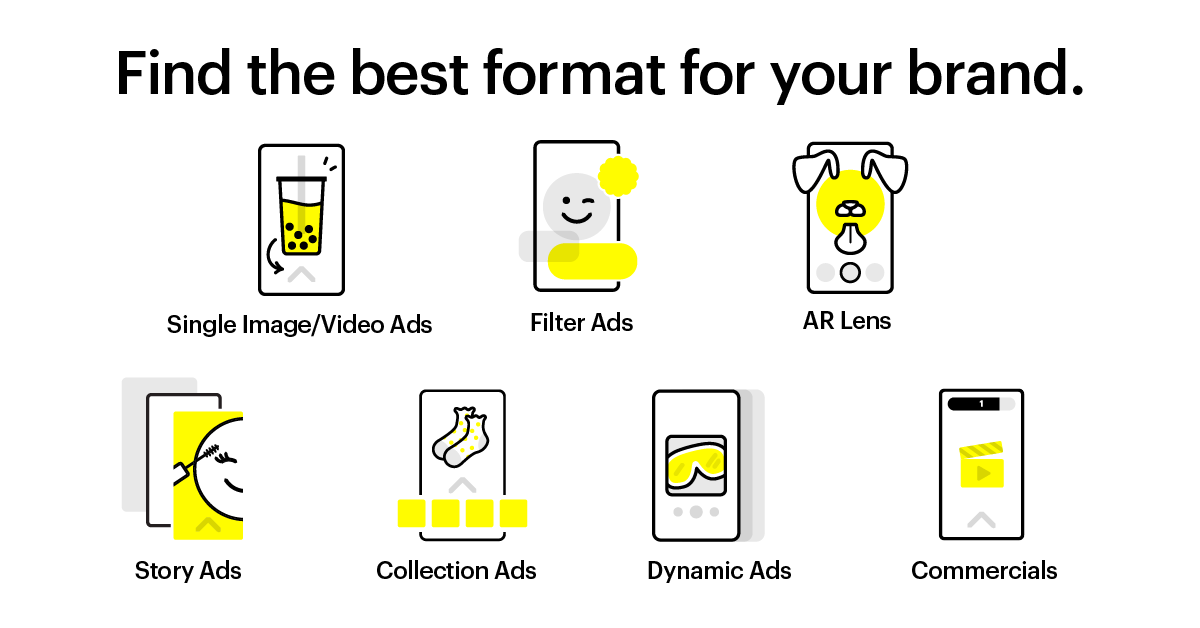
Snapchat offers several formats designed for different advertising goals and customer journeys. Choosing the format based on your objective is more important than simply choosing the newest option. Snapchat currently supports formats including Single Image or Video Ads, Story Ads, Collection Ads, Commercials, AR Lenses, and Filters.
Single Image and Video Ads
These are a practical starting point for new advertisers. They can support awareness, website traffic, remarketing, and conversion campaigns. Snapchat recommends this format for advertisers who are getting started.
Story and Collection Ads
Story Ads let brands combine multiple creative pieces into a connected narrative. Collection Ads are especially useful for ecommerce businesses with several products to showcase. Both formats can move users from discovery toward deeper product consideration.
AR Lenses, Filters, and Commercials
AR Lenses can make advertising more interactive by allowing users to experience branded augmented reality. Commercials provide short non-skippable placements within curated Snapchat content. These formats can work especially well when brand awareness and engagement are important goals.
| Ad Format | Best For | Strongest Advantage |
|---|---|---|
| Single Image/Video | Traffic and conversions | Simple to launch |
| Story Ads | Storytelling | Deeper engagement |
| Collection Ads | Ecommerce | Product discovery |
| Commercials | Awareness | Strong visibility |
| AR Lenses | Engagement | Interactive experiences |
| Sponsored Snaps | Direct engagement | Chat-based reach |
How Snapchat Advertising Works for Businesses
Starting a campaign does not require a complicated process. Snapchat’s current advertising flow focuses on choosing an objective, setting a budget, building an audience, creating the advertisement, and reviewing results.
Create a Snapchat Business Account
Begin by creating your advertising presence and preparing the assets needed for your campaign. Your website, landing page, product feed, or app should be ready before sending paid traffic. Tracking should also be configured before you spend meaningful money.
Choose the Right Campaign Objective
Your objective should reflect the action you actually want customers to take. Snapchat currently organizes its major objectives around Awareness & Engagement, Traffic, Leads, App Promotion, and Sales.
For example, an ecommerce store should prioritize sales rather than simply chasing video views. A new local business may initially focus on awareness or traffic.
Define Your Target Audience
Snapchat provides audience options involving demographics, interests, locations, custom audiences, and lookalike audiences.
Start with an audience that closely matches your existing customers. Then test broader audiences once you have enough performance data.
Build and Launch the Campaign
Create vertical creative that immediately communicates the offer. Add a clear call to action and make sure the landing page matches the advertisement. After launch, avoid making major changes too quickly because campaigns need enough data for meaningful optimization.
How Much Does Snapchat Advertising Cost in 2026?
There is no universal Snapchat advertising cost because spending depends on your campaign, audience, objective, and competition. Snapchat currently states that advertisers can set daily and lifetime budgets and start or stop campaigns whenever needed. Its published minimum daily spend is $5, while it recommends $20–$50 per day to help campaigns move through the exploration phase.
What Determines Snapchat Ad Costs?
Several factors can influence advertising costs, including audience size, location, seasonality, creative quality, bidding strategy, and campaign objective. A campaign targeting a competitive audience can behave very differently from one targeting a smaller niche.
Do not judge performance using CPM alone. A cheaper impression means little if those impressions never produce qualified leads or purchases.
How Much Should a Beginner Spend?
Start with a controlled testing budget rather than committing a large amount immediately. Test several creative concepts and compare meaningful business outcomes. Once you identify a profitable combination, gradually increase spending instead of scaling everything at once.
Snapchat Ads Targeting and Measurement
Good Snapchat business marketing depends on knowing exactly what happens after someone interacts with an advertisement. Impressions and views are useful, but they should not be your final success metrics. Tracking website actions, leads, purchases, and customer acquisition costs gives you a clearer picture.
Snapchat Audience Targeting
Targeting should begin with your ideal customer rather than the largest possible audience. Consider age, location, interests, customer lists, and website behavior when building campaigns. Snapchat also supports Custom and Lookalike Audiences for finding relevant potential customers.
Snap Pixel and Conversion Tracking
Conversion tracking helps connect advertising activity with actual business results. Without reliable tracking, it becomes difficult to understand whether your campaign is generating revenue or simply generating attention.
Metrics That Actually Matter
Focus on metrics that match your campaign objective. Depending on your goal, these can include CTR, CPC, CPA, conversion rate, ROAS, qualified leads, purchases, and customer acquisition cost.
Snapchat Ads vs. Meta and TikTok
Snapchat should be evaluated as part of your wider paid social strategy. Meta often offers broad audience coverage and mature retargeting capabilities, while TikTok is powerful for short-form content discovery. Snapchat can stand out when your customers are younger and your creative benefits from immersive, vertical experiences.
| Platform | Strongest Use Case | Key Advantage |
| Snapchat | Gen Z-focused campaigns | Immersive mobile experience |
| Meta | Broad acquisition | Extensive ecosystem |
| TikTok | Content discovery | Strong short-form culture |
| High-intent searches | Search-driven demand |
Snapchat vs. TikTok
Both platforms can reach younger consumers, but their creative environments are different. Test both when your audience overlaps instead of assuming one platform will always win.
Snapchat vs. Meta
Meta can provide broader demographic coverage and strong retargeting opportunities. Snapchat becomes more attractive when your creative and audience specifically match its strengths.
Snapchat vs. Google Ads
Google captures people actively searching for products or solutions. Snapchat generally works more through discovery and interruption, meaning the creative must create interest before the customer searches.
How to Create Snapchat Ads That Convert
Effective Snapchat advertising is less about producing polished commercials and more about creating content people understand immediately. Your advertisement should feel natural within a fast-moving mobile environment. The first few seconds are particularly important for earning attention.
Make the First Seconds Count
Lead with the problem, benefit, surprising result, or strongest visual. Avoid lengthy introductions that delay the reason someone should care. A clear hook gives viewers a reason to continue watching.
Design for Vertical Mobile Viewing
Use vertical 9:16 creative that fills the screen naturally. Keep important text away from interface elements and make your branding easy to recognize. Snapchat’s current specifications commonly use a 9:16 format for major video and image placements.
Use Authentic and Native-Looking Creative
UGC, demonstrations, creator-style videos, and customer testimonials can make advertisements feel less intrusive. Your goal is not to make every advertisement look expensive. Your goal is to make the message relevant, understandable, and believable.
Pros and Cons of Snapchat Ads for Business
Snapchat offers strong opportunities, but it is not a universal advertising solution. The platform works best when audience, creative, offer, and conversion experience are aligned.
Advantages
The major advantages include strong younger-audience reach, immersive vertical creative, multiple ad formats, audience targeting, and ecommerce opportunities. Businesses can also choose from objectives covering awareness, traffic, leads, app promotion, and sales.
Disadvantages
The biggest limitation is audience fit. Businesses targeting older demographics or highly specialized B2B buyers may find other channels more efficient. Creative testing and proper measurement are also essential because attractive reach does not automatically produce profitable customers.
Which Businesses Should Use Snapchat Ads in 2026?
Snapchat works best when a business can combine visual storytelling with a clearly defined younger audience. Ecommerce, fashion, beauty, food, entertainment, apps, and lifestyle brands are natural candidates for testing. Businesses with older or highly specialized audiences should validate performance before scaling.
Best Business Types
Consumer brands with visually demonstrable products can benefit from Snapchat’s full-screen environment. Ecommerce companies can use Collection Ads to help users browse multiple products. Apps can also use campaigns designed specifically around installations and app actions.
Businesses That Should Test Carefully
B2B companies, professional services, and high-ticket businesses should approach Snapchat as an experiment rather than a guaranteed growth channel. If your customers need extensive education before purchasing, search, email, or other channels may support the buying journey better.
Snapchat Advertising Strategy for 2026
A successful Snapchat advertising guide should focus on testing rather than promises. Start with one clear objective, create multiple creative variations, and measure actual business outcomes. Snapchat also supports multi-format delivery, allowing advertisers to use multiple formats around one objective and budget.
Start With One Clear Goal
Choose one primary outcome for each campaign. This makes optimization easier and prevents your advertising budget from becoming scattered across unrelated goals.
Test Multiple Creative Concepts
Test different hooks, offers, creators, visuals, CTAs, and messaging angles. Keep the audience reasonably consistent while testing creative so you can better understand what drives results.
Optimize Based on Business Outcomes
Do not celebrate a campaign simply because it receives millions of impressions. Ask whether it generates sales, qualified leads, app actions, or another meaningful result.
Final Verdict
Yes, Snapchat can be worth testing when your audience and creative strategy fit the platform. It is particularly interesting for brands targeting Gen Z and younger Millennials with visually engaging products, services, or experiences. The smartest approach is to test Snapchat alongside other channels and scale only after the numbers prove the business case.
For businesses following a practical brandsholder approach, the priority should be building a recognizable brand while measuring real commercial outcomes. Snapchat can contribute to that goal when strategy, creative, targeting, and tracking work together.
FAQs
Are Snapchat Ads worth it for small businesses?
Yes, small businesses can test Snapchat Ads with controlled budgets. The platform allows advertisers to set daily and lifetime spending limits, making gradual testing possible.
What businesses benefit most from Snapchat advertising?
Fashion, beauty, ecommerce, food, entertainment, apps, and lifestyle brands can be strong candidates. The best fit usually combines a younger audience with visually engaging products or services.
How much does Snapchat advertising cost?
Costs vary according to the campaign objective, audience, competition, and budget. Snapchat currently lists a $5 daily minimum and recommends $20–$50 per day for campaigns entering its exploration phase.
Is Snapchat better than TikTok for Gen Z advertising?
Neither platform is automatically better for every business. Snapchat can be particularly useful when your audience and creative align with its messaging-focused, immersive environment, while TikTok may be stronger for content discovery.
Which Snapchat ad format should beginners use?
Single Image or Video Ads are a practical starting point because they are relatively simple to create and can support several objectives. Snapchat itself recommends this format for advertisers getting started.